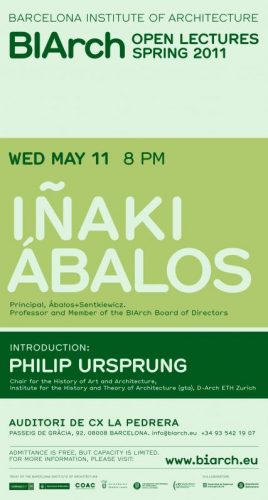
In a precarious environmental context, in which the building industry heads the ranking of activities with the highest carbon footprint (even over and above others, such as transport), sustainability has become the new buzzword on the international architecture scene. As often happens in such cases, the market has beaten theory to the chase and a shift has taken place which, in the words of Iñaki Ábalos, describes a swing between romantic, low-tech origins and a “technocratic”, high-tech conception.
Immersed in this context and conscious of this shift, Ábalos+Sentkiewicz's work—on the theoretical, technical and aesthetic level—seeks to shed light on the rules of the game and put the architect in his rightful place: “Only if a genuine aesthetic discussion takes place, if there is a concept of beauty tied to sustainability, can the latter be of interest to architecture in any non-circumstantial way and can any meaningful response to it be formulated” (Iñaki Ábalos).
The work that Ábalos+Sentkiewicz have been carrying out since 2006 aims to contribute to this debate by postulating as a solution an interplay of trinomials—an algebraic equation comprising three terms connected by plus or minus signs—which could be summed up as follows: technical rigour + formal complexity (architecture + landscape + environment), a trinomial within a trinomial.